


Logitech G Yeti 2 Review Roundup: Critics Love the Smart Mic, but Don’t Expect XLR
Yeti 2 review roundup: critics average 8.8/10 for Logitech G's new USB mic. What they loved about the voice tracking and AI denoiser, and what they didn't.
Image: Logitech G
The Yeti 2 review scores are in, and critics like Logitech G's first true sequel to the Blue Yeti a lot. Across four scored reviews it averages about 8.8 out of 10. Reviewers praise how good it sounds straight out of the box, the voice-tracking sensor and the AI denoiser. The main complaints are that it's USB only, with no XLR, and that its automatic gain can "pump" when you shout.
This is a roundup of what critics say, not our own review: we haven't tested the Yeti 2 ourselves.
Yeti 2 review roundup at a glance
| Price | $159.99 / £139.99 (Logitech G store) |
| Connection | USB-C, no XLR |
| Recording | 24-bit / 48 kHz, three-capsule array |
| Pickup patterns | Cardioid, omnidirectional, bidirectional and stereo |
| Smart features | Voice proximity sensor, AI-powered de-noiser, Blue VO!CE, 10-band EQ |
| Controls | 1.3-inch LED screen, dial, touch mute, G HUB software |
| Size and weight | 289 x 110 x 125 mm, 995 g on its stand |
| Critics' average | About 8.8/10 (4 scored reviews) |
Yeti 2 review scores
- Basic Tutorials (Philipp Briel): 92/100, Gold Award
- Shacknews (David Craddock): 9/10
- AOL (Joshua Boyles): 4.5/5
- Gaming Shogun (Jerry Paxton): 4/5
- Insider Gaming (Grant Taylor-Hill): no score, but very positive
The bigger tech sites have only covered the launch so far, so these scores come from smaller outlets. We'll add more reviews and update the average as they appear.
What is the Logitech G Yeti 2?
The Yeti 2 is the follow-up to the Blue Yeti, the USB microphone that became a favorite of streamers and YouTubers after it launched in 2009. Logitech bought Blue in 2018, and the Yeti 2 now sits under the Logitech G brand. Logitech calls it an "icon reborn": a plug-and-play USB-C mic that starts with its automatic modes switched on, so you "sound your best immediately".
Its big new idea is a voice proximity sensor that tracks where your voice is in 3D and adjusts gain, EQ and more in real time. It also has an AI-powered de-noiser for keyboard clicks, notifications and PC fans, and a 1.3-inch LED screen with a dial for changing settings without software.


What the critics loved
- Great sound with no setup. Shacknews found the default settings "worked as-is" for podcasting, and AOL got "extremely clean audio" with very little tinkering.
- The voice tracking. Basic Tutorials says the proximity sensor "works very well", keeping your level steady as you move, and Gaming Shogun found it smooth in normal conversation.
- A denoiser that actually helps. Shacknews, which is no fan of AI features, says it "comes in handy" and is so unobtrusive it forgot it was on. Insider Gaming had family clapping and shouting in the background and says they were "barely audible".
- The screen. Insider Gaming expected a gimmick but found the little display genuinely useful for checking mute, gain and levels at a glance.
- Build quality. Basic Tutorials gave design and build 95 out of 100, and AOL calls the metal stand "remarkably stable".
- Value. Insider Gaming preferred it to the Elgato Wave:3 and the dearer Razer Seiren V3 Pro, and AOL calls the price "more than fair" for the tech inside.
What the critics didn't like
- No XLR. Basic Tutorials and Gaming Shogun both point out it's USB only, so it can't grow into an audio interface or mixer setup later.
- Auto-gain pumping. Gaming Shogun found a sudden shout makes the volume dip and then "pump" back up, and Basic Tutorials also noticed the automatic gain audibly readjusting.
- Stronger denoising costs quality. AOL found level 2 can clip the start of words after silence, and level 3 lowers audio quality. Gaming Shogun says the strongest setting leaves voices "slightly hollow".
- The dial click. AOL found pressing the dial is audible on recordings.
- The price for casual users. Shacknews thinks around $160 is fair for power users but may put off people who just want a decent mic for calls.

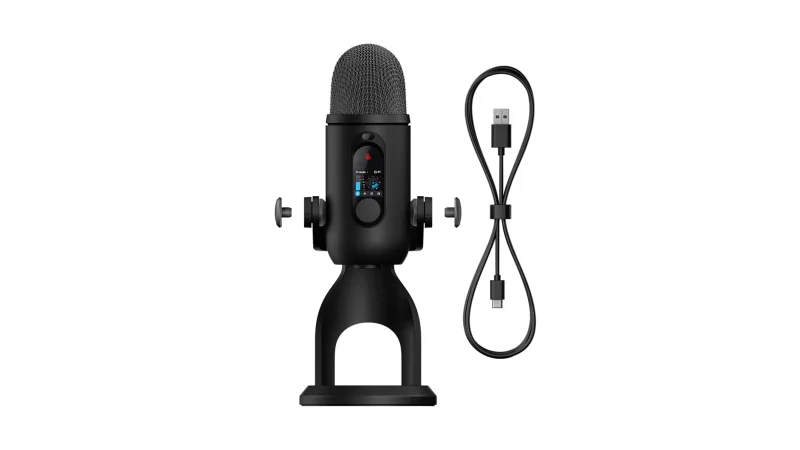
Yeti 2 specs
| Sample rate / bit depth | 48 kHz / 24-bit |
| Frequency response | 20 Hz to 20 kHz |
| Sensitivity | -6 dBFS @ 94 dB SPL |
| Signal-to-noise | Over 77 dB |
| Max SPL | 129 dB SPL @ 10% THD |
| Power | 2.5 W / 500 mA or less over USB-C |
| Warranty | 2 years |
The body and stand are die-cast metal, the screen sits behind bonded glass, and you can save presets to the mic's own memory. A die-cast arm mount is sold separately.
Yeti 2 vs Yeti X: which should you buy?
If you're buying new, the Yeti 2. It's cheaper than the Yeti X was in the US, records at a higher quality, uses USB-C and adds the proximity sensor, AI denoiser and screen. The Yeti X is no longer on Logitech's UK store. Our Blue Yeti X review explains when an older Yeti X can still make sense at a good discount.
Should you buy the Yeti 2?
Critics broadly agree: it's one of the easiest ways to sound good on stream, on Discord or on a podcast, especially if you don't want to learn audio mixing. If you shout a lot while gaming, test the auto-gain or turn it down in G HUB. And if you plan to move to an XLR setup later, a mic with an XLR output will serve you better in the long run.
Critics agree the Yeti 2 is the easiest way to sound great on stream, with clever voice tracking, a useful AI denoiser and superb build. No XLR and some auto-gain pumping keep it from perfection.
What critics liked
- Sounds great straight out of the box
- Voice tracking keeps your level steady
- AI denoiser cuts keyboard and fan noise
- Tough metal build and handy screen
What critics didn’t
- USB only, no XLR
- Auto-gain can pump on loud shouts
- Strongest denoise setting hurts quality
- Pricey if you only need a mic for calls
More tech reviews on iGame Magazine
- Blue Yeti X Review: Is It Still Worth Buying in 2026?: the Yeti 2's predecessor
- Rode PodMic Review: Is It the Best Budget Podcast Mic?: a broadcast-style alternative
- Logitech G PRO X3 SUPERSTRIKE: Price, Specs and the New PRO Range: more new Logitech G gear
Yeti 2 review FAQ

David Ware is the Founder and Managing Editor of iGame Magazine. Since 2024 he has built igamemag.com into a trusted online destination for gamers and tech enthusiasts, covering the latest gaming news, in-depth game reviews, hardware and tech breakdowns, and practical guides.
How we write: every article is researched from official sources, such as developer posts, store pages and press releases, then fact-checked and edited by David Ware before it's published. We use AI tools to help with research and drafting.
Related on iGame
 The Yeti 2's predecessorBlue Yeti X Review: Is It Still Worth Buying in 2026?Apr 9, 2024
 Another streaming mic reviewRode PodMic Review: Is It the Best Budget Podcast Mic?Apr 5, 2024
 More new Logitech G gearLogitech G PRO X3 SUPERSTRIKE: Price, Specs and the New PRO RangeOct 9, 2026
 More Tech ReviewsSurface Laptop Ultra Review Roundup: Beautiful and Powerful, but Not Built for GamersOct 20, 2026
 More Tech ReviewsMSI Claw 8 EX AI+ Review Roundup: Is the Fastest Handheld Worth $1,799?Oct 9, 2026
 More Tech ReviewsSteam Frame Review Roundup: Is Valve’s VR Headset Worth It?Oct 8, 2026